
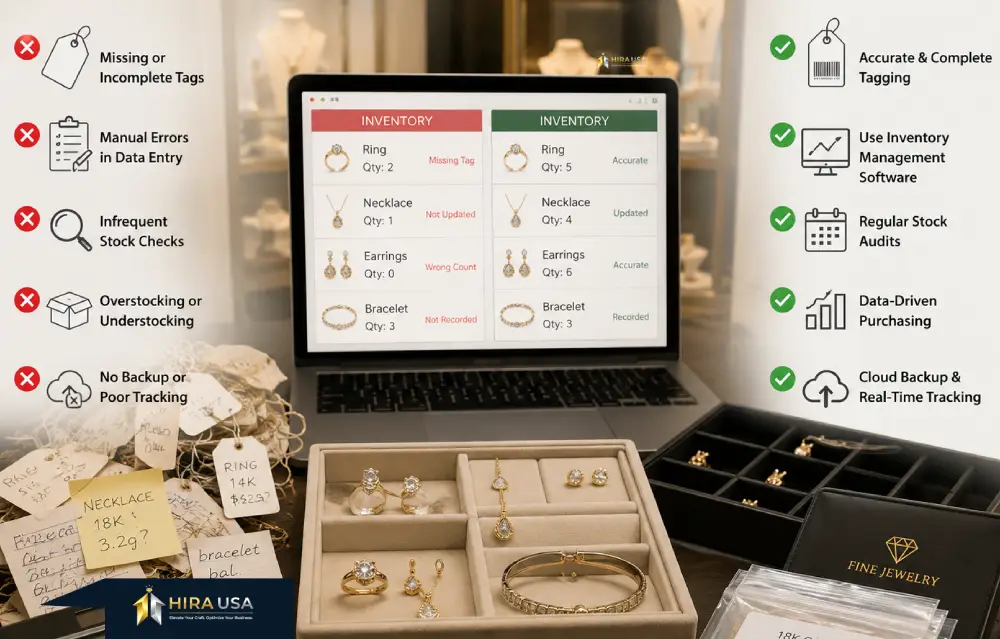
Running a successful jewelry business is an art form, but managing its backbone—the inventory—is a rigorous science. Unlike standard retail environments where products have fixed stock-keeping units (SKUs) and uniform values, a jewelry showroom holds items composed of constantly shifting variables. You are trying to balance fluctuating daily precious metal fixes, complex gemstone carats, varying setting labor fees, and high-value pieces out on consignment.
Because of the intricate system, even minor inventory oversights can quietly drain your cash flow, skew your profit margins, and frustrate your clients.
Many independent retailers view inventory management as a passive, back-office chore to be dealt with during annual tax evaluations. However, by identifying the most common pitfalls in jewelry inventory tracking and leveraging automated solutions like HiraUSA, you can eliminate costly manual errors and secure your shop’s financial health.
1. Relying on Static Spreadsheets and Paper Logs
Perhaps the most widespread mistake in the modern jewelry trade is the continued reliance on manual tracking systems, such as basic Excel spreadsheets or handwritten bookkeeping. While these methods might seem manageable when you first launch, they quickly fall apart as your business scales.
A spreadsheet cannot communicate dynamically with your sales floor or your workshop bench. When a piece is sold, altered for a custom sizing, or sent to another branch, someone must remember to manually update the sheet. This gap in time creates a dangerous blind spot where your team might promise an item to an eager client that was sold days prior, directly damaging client trust.
2. Failing to Log the “Complete DNA” of a Piece
Generic retail inventory systems look at an item as a single finished unit. In the luxury trade, however, a piece of jewelry is a complex assembly of separate, high-value components. Failing to track the distinct parts of an item is a massive administrative mistake.
An organic, expert approach requires your jewelry inventory software to capture the granular breakdown of every piece the moment it enters your vault:
The Alloy breakdown: Recording the exact gross weight versus the clean net metal weight, along with its specific karatage (e.g., 14K, 18K, or Platinum).
The Gemstone parameters: Mapping individual stone weights, cuts, colors, and clarities along with their corresponding grading certificates (such as GIA or IGI reports).
The Labor costs: Separating the raw material value from the artisan or design fees.
Without this granular visibility, calculating accurate margins becomes nearly impossible, especially when precious metal market prices fluctuate daily.
3. Neglecting the Rhythm of Rolling Audits
For many retail teams, the word “audit” triggers immediate anxiety, implying a stressful, late-night physical count where the showroom must close its doors. Because it is viewed as a massive chore, many retailers skip regular checks entirely, opting instead for a single, sweeping annual count.
Waiting twelve months to audit your vault means you will only catch discrepancies long after the damage is done. In contrast, high-performing retailers avoid this by integrating fast, rolling cycle counts into their weekly schedules.
By utilizing scannable barcode or RFID tags paired with a dedicated business platform, a showroom manager can scan a single display tray or a specific diamond collection in just a few minutes. This turns a dreaded administrative burden into a calm, twenty-minute weekly routine, allowing you to catch internal errors or missing items before they impact on your end-of-year books.
4. Fragmented Tracking Across Multiple Channels and Locations
If your business operates across multiple brick-and-mortar storefronts, exhibits at trade shows, or sells pieces online, keeping your stock aligned is incredibly challenging. A common mistake is allowing each sales channel to run on a separate, unlinked system.
This lack of integration leads to “shadow stock”—where an item is sitting completely forgotten in a safe at Location A while Location B places an emergency order with jewelry manufacturers for an identical piece. Capital becomes needlessly trapped in duplicate inventory.
Transitioning your multi-store or omni-channel footprint to a centralized, cloud-integrated dashboard fixes this instantly. Your sales team can securely view and sell stock across your entire enterprise live, maximizing your inventory turnover rate.
5. Siloing Inventory from the Accounting Ledger
Your inventory figures and your financial books should never live in isolation. When physical stock movements aren’t directly linked to your general ledger, calculating an accurate cost of goods sold (COGS) becomes an incredibly complex math puzzle.
Manual bookkeeping entries to account for metal price adjustments, scrap trade-ins, or manufacturing expenses are highly prone to transcription errors. True operational efficiency happens when your inventory updates your accounting books automatically with every transaction. This level of cross-functional transparency ensures that every invoice, vendor payout, and custom design quote is perfectly accurate to the penny.
The Modern Solution: Centralized Command with HiraUSA
Avoiding these common inventory mistakes doesn’t require extra hours of manual oversight; it simply requires the right tools.
Implementing an all-in-one platform like HiraUSA unifies your entire business into a single source of truth. As a robust ERP solution for diamond traders and retailers alike, it bridges the gaps between your front-end sales team, your back-office accounting ledger, and your manufacturing hubs.
Whether you are tracking heavy loose stone parcels, organizing custom orders from manufacturers, or managing everyday retail showcases, having a dedicated system behind your vault provides the operational clarity, security, and accuracy your business needs to grow.
Ready to Secure Your Margins?
Running your business on paperwork, spreadsheet guesswork, and fragmented retail tools will inevitably cap your ability to scale. If you are ready to eliminate stock discrepancies, speed up your client checkout times, and gain total control over your true profitability, it is time to upgrade your workflow.
Contact us today to schedule a live, personalized demo and discover how HiraUSA can seamlessly streamline your inventory operations and protect your bottom line.


