
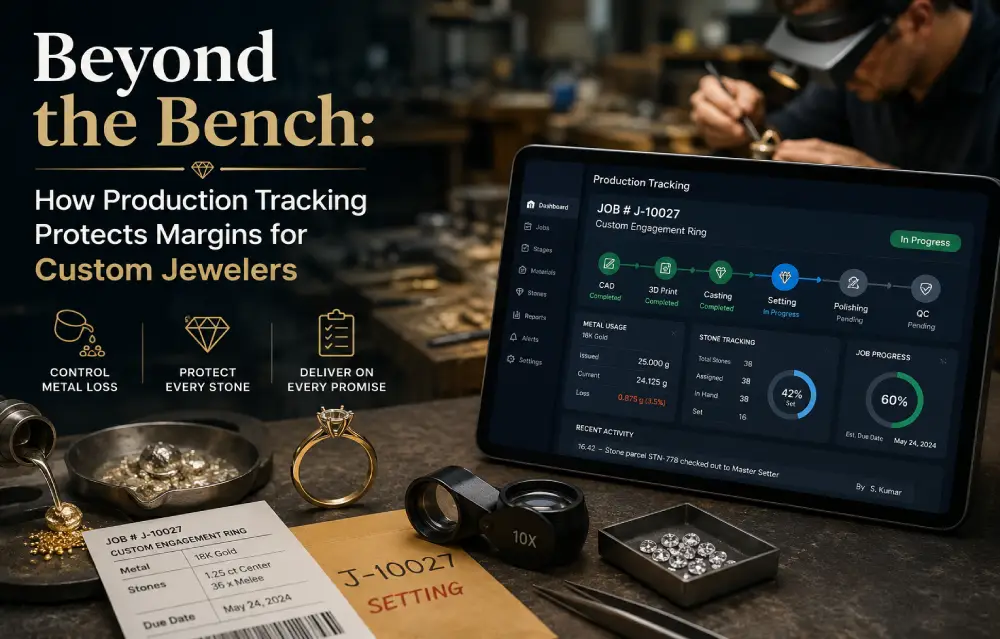
If jeweler run a custom manufacturing shop or a design house, they already know that the workshop floor is where the real craft happens—and where profit margins face their toughest test. Turning a CAD rendering into a finished piece of fine jewelry is a complex, multi-stage journey through 3D printing, casting, cleaning, stone setting, polishing, and quality control.
Unlike standard retail manufacturing where raw materials are uniform and stable, jewelry production handles volatile, high-value assets. When you manage custom jobs using paper job envelopes, physical whiteboards, or offline spreadsheets, subtle leaks happen at every bench.
To maintain healthy margins, protect loose diamonds, and deliver on customer promises, modern jewelry businesses are replacing manual guesswork with real-time digital production tracking.
The Hidden Leaks on the Workshop Floor
In fine jewelry manufacturing, a single order moves across multiple specialized hands. Without a clear digital chain of custody, several operational bottlenecks inevitably emerge:
Unaccounted Metal Loss: When 18K gold grain or platinum stock is melted, cast, filed, and polished, a fraction of the weight naturally vanishes as sprue scrap, crucible residue, or polishing dust. Without systematic logging at each bench stage, calculating true “polishing loss” versus actual inventory leakage becomes impossible.
Loose Stone Discrepancies: Handing a master setter a parcel of melee diamonds or a high-carat certified stone without an immediate digital check-out system creates accountability gaps. If a stone is chipped during setting or misplaced in transit, tracking down where the error occurred takes hours of investigation.
Communication Blind Spots: When a client calls to ask about their custom engagement ring, front-counter staff shouldn’t have to walk back to the workshop to hunt through physical job bags. A lack of real-time visibility leads to missed deadlines and strained client trust.
How Digital Production Tracking Works in Practice
Replacing physical job bags with a scannable, digital workflow creates a transparent digital thread for every piece created.
1. CAD, Wax, and Casting Allocation
The process begins by assigning a unique digital barcode or RFID tracking tag to the job order. When raw 24K gold grain or alloy stock is issued from the central vault, the weight is recorded digitally. Once the rough casting comes out of the investment mold and the sprue button is removed, it is weighed again. The system automatically tracks metal shrinkage and initial casting loss before the piece even reaches the jeweler’s bench.
2. Bench Assignment and Stone Checkout
As the piece moves to the stone setter, loose diamonds or colored gemstones are scanned out of the central vault and assigned directly to that job ticket. The software logs the precise carat weights, stone grades, millimeter measurements, and setting instructions. When the setter finishes, scanning the piece back into the system confirms that all assigned components are accounted for down to the point.
3. Automatic Cost of Goods Sold (COGS) Roll-Up
Once final polishing and quality control are complete, the software aggregates every input cost: the net precious metal weight, the exact stone costs pulled from inventory, and the specific labor rates accrued for CAD design, casting, setting, and polishing. This gives management an instant, accurate Cost of Goods Sold (COGS) roll-up, revealing true net profit margins down to the penny.
Connecting the Production Bench to Sales and Operations
A digital production workflow doesn’t just streamline the workshop; it unifies your entire business ecosystem.
For businesses with direct-to-consumer showrooms, implementing a jewelry ERP for retailers allows sales consultants to check custom job statuses right from the sales counter, giving clients instant, accurate delivery updates without interrupting bench jewelers.
For high-volume B2B operations, utilizing a dedicated jewelry ERP for wholesalers helps manage large-scale casting runs, track bulk loose stone allocations, oversee contracted third-party manufacturing houses, and maintain clear delivery schedules for retail partners.
Evaluating the Transition to Modern ERP Systems
Upgrading your production floor from paper job bags to a centralized digital platform requires careful planning and a clear understanding of your operational needs.
When evaluating potential solutions, business leaders look closely at jewelry ERP pricing structures to ensure the platform scales predictably with their manufacturing volume. Equally critical is a structured jewelry ERP implementation strategy—a process that involves mapping out your exact bench stages, setting up scannable tracking protocols, migrating raw material balances, and training bench jewelers on simple digital check-ins.
Streamline Your Workshop with HiraUSA
Achieving complete visibility over your production line, securing your loose stone inventory, and protecting your manufacturing margins doesn’t require extra hours of manual oversight; it simply requires the right tools.
As an all-in-one management platform, HiraUSA bridges the gap between your design desk, your central vault, your master bench jewelers, and your accounting ledger. By automating weight loss calculations, tracking loose stone custody, and rolling up true component costs, it provides the operational clarity your custom jewelry business needs to scale safely.
Experience the System First-Hand
If you are ready to eliminate metal weight discrepancies, speed up custom turnarounds, and gain total control over your true manufacturing costs, it is time to see a specialized trade platform in action.
Contact us today to schedule your live jewelry ERP demo and discover how HiraUSA can seamlessly streamline your production tracking, eliminate errors, and safeguard your bottom line.


