

It is 4:30 PM on a Thursday. A private retail client calls your desk asking for a 2.05-carat, F-color, VS1 round brilliant diamond with an excellent cut and negligible fluorescence. You check your system, verify the GIA report number, quote the stone based on your active price list, and close the agreement.
Then your shipping coordinator walks into your office with bad news: that exact stone was sent out on a five-day memo to a jeweler in Chicago two mornings ago. The paperwork was sitting in a physical tray waiting to be logged, but the digital spreadsheet never got updated.
Now, you have two choices: scramble to call back the Chicago jeweler and ask for the stone back, or call your client and explain why a confirmed diamond is unavailable.
In high-value diamond trading, this operational disconnect happens far too often. Managing certified inventory with disjointed spreadsheets, paper consignment slips, and generic retail tools creates blind spots that risk hard-won client relationships and eat away at margins.
Here is a step-by-step breakdown of how modern dealers and jewelers use specialized diamond ERP software to track certified stones seamlessly from the moment they enter the vault to final settlement.
The Traceability Challenge in Certified Diamond Trading
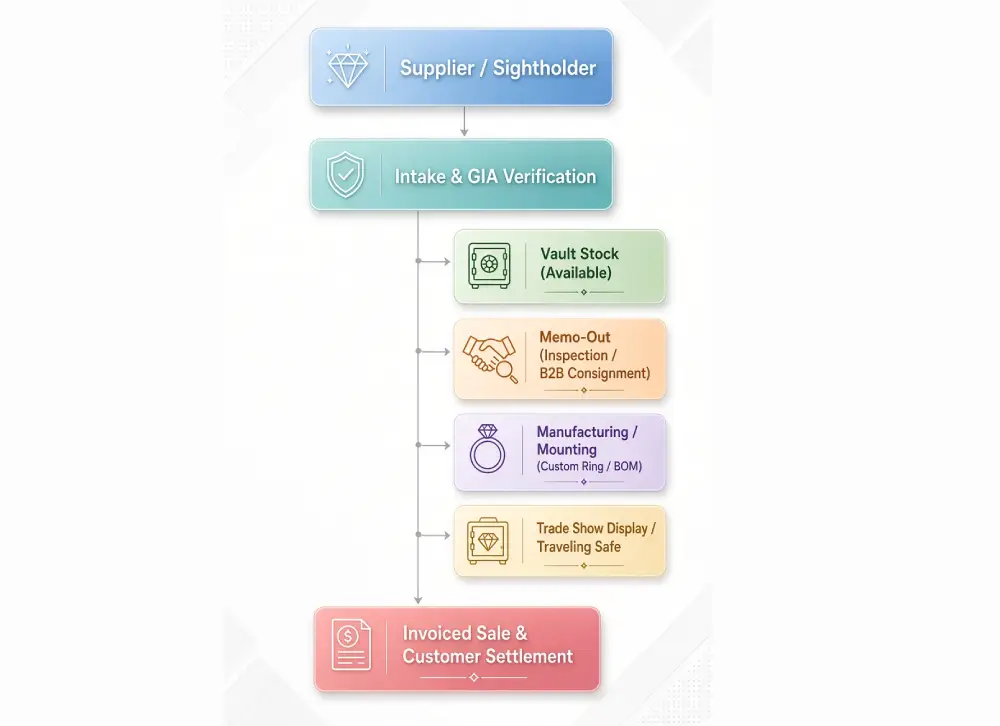
Certified loose stones are not interchangeable retail SKUs. Each stone possesses unique grading attributes, distinct provenance, and high capital value. Between initial purchase and final customer invoicing, a certified diamond moves through several hands and operational states:
Schedule a Personalized Demonstration with HiraUSA Today →
When businesses rely on generic bookkeeping tools or isolated spreadsheets, three critical problems emerge:
- The Memo Black Hole: Diamonds out on memo—whether for customer viewing, retail consignment, or mounting evaluation—vanish from real-time visibility. Tracking returns, aging memos, and consignment terms becomes a manual, error-prone chore.
- Double-Entry Errors on Lab Specs: Typing 20+ stone specifications (table, depth, polish, symmetry, fluorescence, dimensions) into multiple platforms wastes time and leads to costly typographical errors.
- Margin Leakage: If you cannot track landed costs—such as grading fees, customs duties, insurance, and transit costs—against rapid price fluctuations, your true realized margins remain a guessing game.
Solving these issues requires dedicated diamond inventory software engineered specifically around the operational realities of the jewelry trade.
Step 1: Digital Intake and Direct Lab Data Verification
Tracking begins the moment a parcel or certified single stone enters your receiving department.
Instead of typing measurements and clarity characteristics manually, modern diamond ERP software connects directly to grading databases or imports standard lab data files.
- Instant Spec Population: Entering or scanning the GIA report number allows the system to pull the official grading parameters directly: carat weight, color, clarity, cut grade, polish, symmetry, fluorescence, measurements, and table/depth percentages.
- Digital Dossier Creation: The stone is assigned a unique internal Stock Keeping Unit (SKU) or barcode tag, linking the physical diamond directly to its digital GIA PDF report and laser inscription records.
- Landed Cost Allocation: The system records not just the purchase price per carat, but also inbound freight, customs, insurance, and certification fees. This establishes an accurate cost basis before the stone ever reaches the sales floor.
Step 2: Live Stock Segregation and Multi-Location Visibility
In an active diamond enterprise, stones rarely stay in one central safe. They are distributed across branch offices, showroom display cases, and traveling sales kits.
Purpose-built diamond management software maintains clean boundaries between locations:
- Vault vs. Showroom: Know exactly which safe tray or showcase holds each certified stone.
- Virtual Locations for Trade Shows: When moving stones to events like JCK Las Vegas or international exhibitions, staff can transfer goods into a temporary “Trade Show Safe” via barcode or RFID scans. This maintains full chain-of-custody tracking between headquarters and floor staff.
- Status Flags: Stones are clearly marked as Available, Reserved, In-Transit, or Under Work Order, preventing sales reps from offering stones that are already committed to another deal.
Step 3: Streamlining Memo-In and Memo-Out Workflows
Consignment and memo transactions are the lifeblood of the diamond business, but they represent the greatest operational risk if managed poorly.
Using diamond trading software, the entire memo lifecycle is documented with audit-ready accuracy:
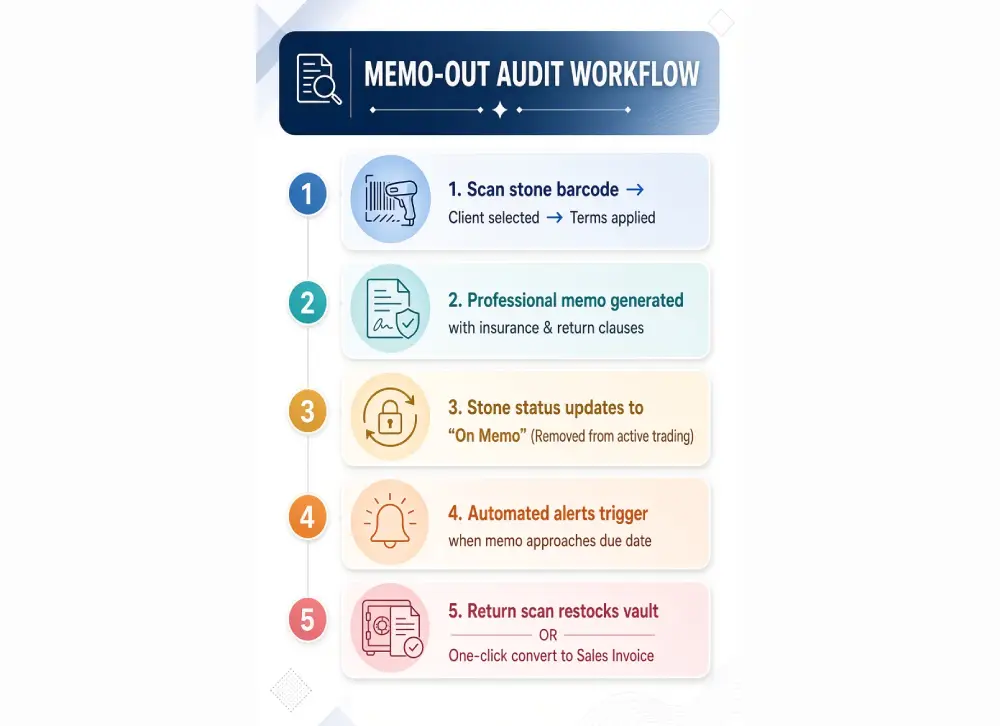
When a stone is placed on Memo-Out:
- Terms and Liability: The system prints a legally clear memo slip detailing agreed-upon evaluation periods, insured values, and specific return requirements.
- Instant Status Update: The stone is instantly flagged as “On Memo.” It cannot be accidentally quoted as “in-vault” to another buyer, protecting your business reputation.
- Aging Alerts: Automated notifications warn your sales desk when a memo exceeds 7, 14, or 30 days without return or settlement.
- Fast Reconciliation: If the client takes the stone, the memo converts directly into an accounts receivable invoice with a single click. If returned, scanning the barcode verifies the stone back into active inventory immediately.
Step 4: Tracking Stones Assigned to Custom Jewelry Manufacturing
When a certified diamond is sold not as a loose stone, but as the centerpiece of a finished engagement ring or pendant, standard inventory tools fall apart.
A dedicated diamond ERP connects loose diamond tracking with manufacturing and Bill of Materials (BOM) workflows:
- Component Allocation: The loose stone is pulled from certified inventory and linked to a specific manufacturing job order, along with the mounting, accent melee diamonds, and casting metals.
- Labor & Setting Tracking: Setting fees, polishing labor, and custom CAD charges are added directly to the project ledger.
- Finished Piece Genealogy: When the finished piece is completed, the ERP retains the original loose stone’s GIA report number, linking the physical piece to its grading heritage for the end consumer.
Step 5: Market Listing vs. Back-Office Reconciliation
Many dealers list their certified stones across international B2B trading platforms such as RapNet to maximize buyer reach.
However, trading marketplaces are built for discovery, not full business management. They do not manage your internal accounting, supplier bills, customer credit limits, or physical vault audits.
When your sales channels are supported by comprehensive diamond ERP software:
- Inventory states stay accurate across every trading avenue.
- Stones out on memo or under production are delisted or flagged as unavailable, preventing double-selling disputes.
- Sales prices can be benchmarked against Rapaport price guidelines using rule-based formulas (e.g., specific discounts off Rap based on clarity and cut quality).
Spreadsheets vs. Dedicated Diamond ERP: A Quick Comparison
| Feature / Process | Manual Spreadsheets & Paper Slips | HiraUSA Diamond ERP Software |
| GIA Spec Intake | Manual typing; vulnerable to keystroke errors | Direct lab cert lookup; auto-populates all 4Cs and measurements |
| Memo Tracking | Written receipts filed in physical binders | Digital Memo-Out logs with automated aging and return alerts |
| Cost Transparency | Hard to track ancillary costs (freight, cert fees) | True landed cost calculated per carat automatically |
| Multi-Location Control | Requires periodic manual physical reconciliations | Live visibility across vaults, branch offices, and trade shows |
| Manufacturing Link | Disconnected from loose inventory records | Direct integration between loose stones and custom jewelry BOM |
Take Control of Your Certified Inventory with HiraUSA
Losing track of certified stones, dealing with clerical errors on grading reports, or finding out a quoted diamond was already promised elsewhere damages your bottom line and your standing in the trade.
HiraUSA’s specialized diamond ERP software provides the clarity, traceability, and operational control your business needs to trade with total confidence. From automatic GIA specification lookups to effortless memo tracking and multi-vault controls, our software is built around the daily realities of the diamond and jewelry industry.
Ready to modernize your diamond inventory workflows?
Schedule a Personalized Demonstration with HiraUSA Today →
Frequently Asked Questions
Can diamond ERP software track both certified single stones and melee parcels?
Yes. Dedicated diamond software handles serialized, certified single stones (where each diamond has an individual identity and cert number) as well as uncertified melee parcels. For parcels, the system tracks initial lot weight, average cost per carat, depletions during production, and remaining balance weights.
How does the system handle stones sent out for recutting or regrading?
When a stone is sent to a diamond cutter for repair or resubmitted to GIA for an updated certificate, the ERP logs it under a dedicated “Outside Service / Lab Work” status. This tracks the stone’s custodian, logistics tracking number, and associated processing costs, which are added directly to the stone’s cost basis upon return.
What happens if a customer returns only part of a diamond memo?
The software allows partial settlements. If a retail client takes five diamonds on memo, decides to purchase two, and returns three, you can invoice the two purchased stones and scan the remaining three back into your vault in a single transaction.
Does diamond management software replace accounting tools like QuickBooks?
Comprehensive diamond ERP platforms often include built-in accounting functions tailored to the jewelry trade (such as foreign currency handling, gold/metal ledgering, and multi-tier tax tracking). Alternatively, systems like HiraUSA can interface with standard accounting software to keep your general ledger aligned with your inventory movements.
Can staff access diamond inventory records securely from trade shows?
Yes. Cloud-based diamond software allows authorized team members to look up certified stock, verify GIA report details, check live pricing, and generate digital memos directly from a tablet or laptop while working remotely or at industry trade events.
“Notice: Some advanced automations and integrations described here are part of an ongoing staged rollout. For currently available features and tier inclusions, refer to the HiraUSA Pricing & Feature Matrix.”


