How to Stop Losing Jewelry Deals to Phantom Stock and Outdated Prices
Every jeweler and wholesaler knows the sinking feeling of this conversation:
A buyer stands in your office ready to take three dozen 14k tennis bracelets and twenty 1.5-carat certified ovals. You check the Excel sheet on your monitor. The quantities look good. You shake hands, start pulling trays from the safe, and then hit a wall.
Eight of those ovals were handed off on memo two days ago to an independent dealer down the street. The bracelets? Six are at your suburban store, five are waiting on bench repairs, and the main vault only has enough cast mountings to finish half the order.
By the time you finish digging through paper slips and texting branch managers, the buyer has checked their watch, made a polite excuse, and walked out the door.
That is how deals die in this trade.
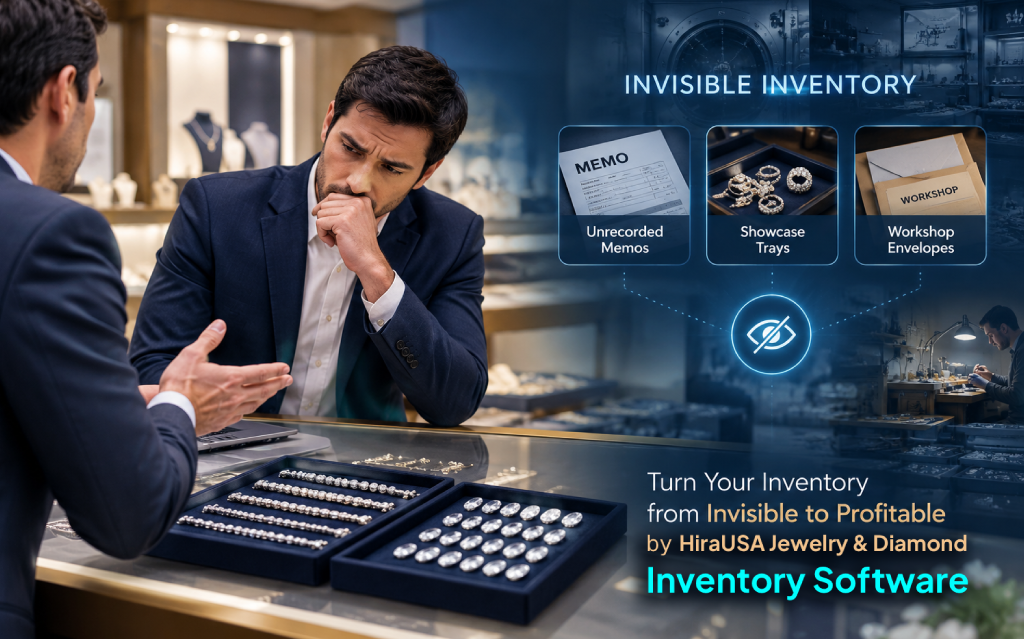
Most jewelry businesses don’t actually suffer from a shortage of inventory. What hurts them is invisible inventory—goods locked away in unrecorded memos, scattered between showcase trays, or buried in workshop envelopes. When your stock is blind, you turn away ready money while your capital sits idle in dead metal and slow-moving parcels.
Notice: Staged Rollout & Feature Availability
Some advanced automations and integrations described here are part of an ongoing staged rollout. For currently available features and tier inclusions, refer to the HiraUSA Pricing & Feature Matrix.
Where the Money Leaks Out
When an operation runs on paper memo pads, standalone cash registers, and shared spreadsheets, profit margins get quietly chipped away in three places:
1. The Memo Fog
You hand out loose stones and high-ticket mountings on memo so retail partners can close deals. But unless that transfer updates your central books the second the package leaves your desk, those goods become ghost inventory. Your sales team can’t sell them, your floor staff assumes they’re in the safe, and days turn into weeks before anyone follows up on aging slips.
2. Pricing on Yesterday’s Market
Gold and platinum move every day. Diamond price lists update regularly. If your tags and wholesale price quotes don’t automatically adjust against current spot metal rates and stone benchmarks, you end up doing the math on the back of an envelope. In a volatile market, selling a mounting at last month’s gold price is just handing your margin directly to the customer.
3. Idle Trays and Stagnant Bins
Without real numbers showing what moves each week, it’s easy to tie up fifty thousand dollars in sizes, cuts, or styles nobody is asking for, while constantly running bone-dry on your best-selling staple mountings and solitaire sizes.
A dedicated jewelry trading software system fixes this by connecting your safes, sales counters, and wholesale books into one live view.
How Dedicated Software Keeps Your Stock Honest
Real Memo Tracking Across Every Safe and Case
Good jewelry inventory software treats memo like what it actually is: your property sitting in someone else’s hands.
- You log an item onto a memo with a quick barcode scan, and its status changes instantly across your whole system. No one can accidentally double-promise it.
- When the client decides to keep a stone, one click turns that memo straight into an accounts receivable invoice.
- If they return it, scanning the tag checks it back into active vault stock right away.
- You see exactly how many grams and carats are sitting in your central safe, out in branch showcases, or packed in a traveling trade show box.
Dynamic Pricing Tied to Daily Spot Rates
With a proper jewelry trading ERP, you don’t have to re-tag items by hand every time the metal market swings.
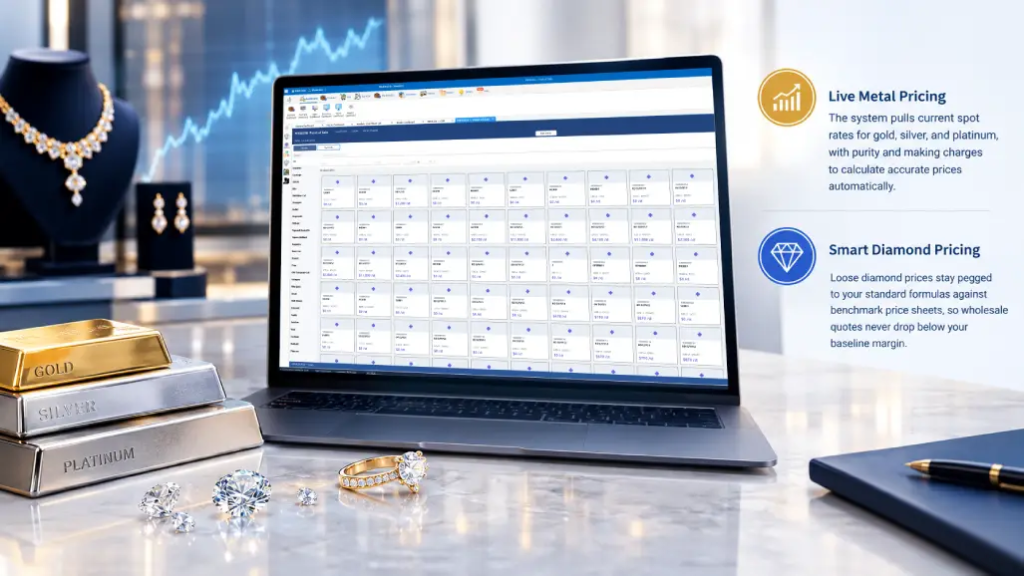
- The system pulls current spot rates for gold, silver, and platinum, factoring in purity (10k, 14k, 18k, 950 Plat) and labor/making charges to calculate accurate prices automatically.
- Loose diamond prices stay pegged to your standard formulas against benchmark price sheets, so wholesale quotes never drop below your baseline margin.
Wholesale Orders and Retail Counters on the Same Ledger
Running wholesale on one system and retail counters on another is a recipe for mismatched books. Bringing jewelry wholesale software and jewelry POS software together means:
- Custom job orders, wholesale memos, and walk-in counter sales pull from the same inventory records.
- Sales reps can put items on hold or ship partial orders without leaving phantom quantities in the system.
- Fast barcode scans make regular tray counts quick enough that staff can actually finish them without staying late.
Matching New Intake to What Customers Actually Want
Deals slip through the cracks simply because the right stone landed in your intake tray, but nobody remembered which customer had asked for it two weeks prior.
- A built-in jewelry CRM lets you log customer want-lists—down to specific millimeter sizes, color ranges, and budgets.
- When a matching parcel is broken down or a finished ring arrives from the bench, your sales rep gets an immediate ping.
- You pull up a customer’s whole history—open memos, past orders, credit terms—right while you’re talking to them on the phone.
Spreadsheets vs. Dedicated Jewelry ERP
| The Daily Routine | Spreadsheets & Paper Slips | HiraUSA Platform |
| Checking Memo Status | Hunting through physical receipt binders | Instant search showing what’s out, who has it, and overdue dates |
| Adjusting for Gold Swings | Manually recalculating piece by piece | Prices update on the fly using daily spot rates and purity formulas |
| Tray & Safe Audits | Tedious, multi-hour hand counts prone to errors | Rapid barcode scans that flag missing pieces immediately |
| Handling Client Requests | Sticky notes and scattered emails | Automated match alerts whenever requested items enter inventory |
Frequently Asked Questions:
How does this software actually stop stockouts?
It tracks what you have available versus what is committed. Because items out on memo, on hold, or assigned to a custom bench job are flagged instantly, your staff never quotes goods you can’t deliver or turns away buyers for pieces sitting in another branch safe.
Can it manage wholesale distribution and counter retail at the same time?
Yes. It handles wholesale invoices, broker commissions, and volume memo runs on the back end, while handling counter checkout, trade-in scrap, split tenders, and customer deposits on the front end.
How does the system handle swinging gold prices?
The platform calculates finished jewelry prices using current metal spot rates, karat purity, and making charges, keeping your margins protected no matter where gold moves.
What does a jewelry CRM do differently from standard software?
Standard business CRMs don’t understand diamond shapes, millimeter tolerances, or open memos. A jewelry CRM links customer profiles directly to their buying history, credit limits, and specific gemstone want-lists.
Where can I check current pricing and feature availability?
You can view per-user monthly rates and the complete feature breakdown directly on the HiraUSA Pricing Page.
Get a Clear View of Your Inventory
You don’t need more stock to grow your revenue—you just need to know exactly where your current stock is, what it costs, and who is ready to buy it.
When you replace paper pads and disconnected spreadsheets with tools built specifically for the jewelry trade, deals close faster, memos come back on time, and your profit stays where it belongs.
Want to see how HiraUSA works on your sales floor?
Book a Live Walkthrough with HiraUSA →