
A friend of mine who runs a small diamond trading desk once asked me, half-joking, “What exactly is ERP, and why does everyone keep telling me I need one?”
It’s a fair question. The term gets thrown around a lot in the trade, often by software vendors who never explain what it actually does differently from the Excel sheets and registers he was already using.
So, here’s the plain-language version, without the jargon.
The Simple Definition
ERP stands for Enterprise Resource Planning, which is a fairly generic term for software that connects the different parts of a business—inventory, sales, purchasing, and accounting—into one system instead of leaving them as separate, disconnected processes.
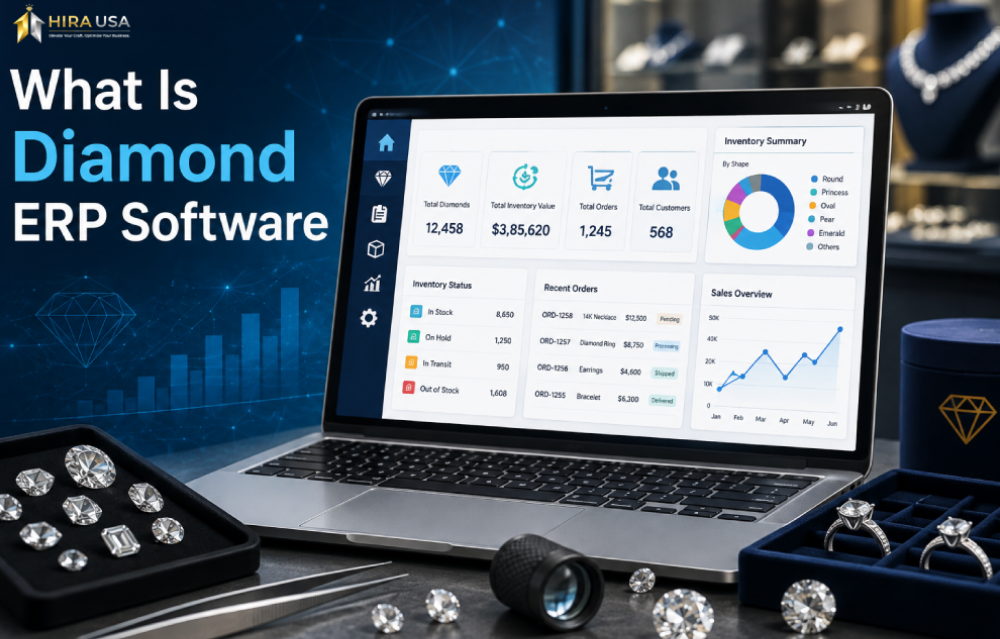
A diamond ERP is that same idea, but built specifically around how diamonds actually move through a business: parcels, certificates, memo stock, consignment stock, and constantly shifting prices based on the four Cs.
Generic ERP systems, the kind built for retail or general trading, don’t really understand any of that. They can track a “product” going in and out of stock, but they have no concept of a diamond’s certificate number, its clarity grade, or the fact that half your inventory might currently be sitting with a buyer on memo rather than actually sold.
That’s the entire reason diamond business software exists as its own category, rather than businesses just using whatever generic accounting package happens to be popular.
What It Actually Does
Strip away the sales pitch, and a diamond ERP handles a handful of core jobs:
– Tracking individual stones or parcels, often down to the certificate level, through every stage from purchase to sale.
– Managing memo stock diamonds sent out to buyers on approval, so you always know what’s physically with you versus what’s out with someone else and for how long.
– Syncing pricing against current market rates, since diamond pricing shifts with Rap Lists and needs to be accurately reflected in quotes and invoices.
– Connecting accounting to actual stock movement, so a sale, a return, or a memo conversion updates your books automatically instead of requiring a manual entry.
– Managing relationships, tracking which buyers prefer which types of stones, what they currently have on memo, and their payment history.
A well-built diamond CRM software module usually sits inside the same system, so sales and relationship data aren’t a separate tool bolted on afterward; they’re part of the same connected picture as inventory and accounting.
Why This Matters More in the Diamond Trade Specifically
Diamonds carry a few operational headaches that most other types of inventory don’t.
Each stone is genuinely unique. No two are identical in the way two units of a manufactured product are. So, tracking by certificate and specific characteristics matters in a way it simply doesn’t for most retail inventory.
Memo stock adds another layer entirely: a huge portion of the trade’s inventory, at any given time, isn’t in your possession at all, which makes accurate, real-time tracking essential rather than optional.
Add to that the fact that many traders operate internationally, dealing in multiple currencies, multiple certification bodies, and buyers spread across different markets, and you start to see why generic accounting software falls short so quickly.
A cloud-based diamond trading ERP software setup solves a good chunk of this simply by being accessible from anywhere. A trader checking stock from a trade show floor or confirming a memo status while traveling isn’t stuck waiting to get back to an office computer.
Is It Only for Large Trading Houses?
This is probably the most common misconception.
People hear “ERP” and assume it’s built for large operations with dozens of staff, and that a smaller desk doesn’t need the complexity. In practice, it’s often the smaller operations that feel the pain of manual tracking the most, simply because they don’t have a dedicated back-office team to catch mistakes before they become expensive.
A missed memo return or a stone that isn’t accurately priced against the current market can hurt a small trader’s margins just as badly, proportionally, as it would a larger house.
Modern cloud jewelery ERP software built for diamonds tends to scale down just as well as it scales up. A solo trader and a fifty-person trading house can use the same core system, just with different volumes of data running through it.
The pricing and setup usually reflect that, too, so a small desk isn’t paying for infrastructure or complexity it doesn’t need.
There’s also a trust factor worth mentioning. In a trade built heavily on relationships and reputation, being able to answer a buyer’s question about stock or memo status accurately and immediately says something.
It’s a small thing, but over years of dealing with the same buyers, it adds up to the kind of reliability that keeps relationships intact.
What to Look For
If you’re evaluating options, the things worth checking are whether the system actually tracks diamonds at the certificate and parcel level rather than treating them like generic stock; whether memo management is a real, built-in feature rather than an afterthought; whether it connects to accounting automatically; and whether it’s accessible from wherever you actually work, not just from one desktop in one office.
This is the exact gap HiraUSA was built to close: a system that treats diamond inventory, memo stock, pricing, and accounting as one connected picture instead of five separate habits held together by memory and paperwork.
Where This Leaves You
A diamond ERP isn’t really about replacing anything you’re already doing well; it’s about giving that work a system that actually understands the trade instead of forcing diamonds into a mold built for something else.
Reach out to the HiraUSA team for a free demo and see what a system built specifically around diamond trading looks like in practice.


