
A few years back, I sat in on a stock audit at a family-run manufacturing unit that had been in business for three generations. It took four full days, three people with calculators, and a fair amount of arguing over a missing 40 grams of gold that eventually turned up as a rounding error in someone’s handwritten register. Nobody was doing anything wrong — they were just doing things the way they’d always been done, on paper, hoping it added up at the end.
That’s the story of most jewelry manufacturers before automation enters the picture. It’s also why digital, connected production systems have stopped being a trend and become a necessity. Gold prices move by the hour, customers expect custom orders turned around in days, and margins are thin enough that a small tracking error can quietly wipe out a month’s profit before anyone notices. If you’re still running production on registers, WhatsApp messages to craftsmen, and Excel sheets, this is worth a few minutes of your time.
What Automated Jewelry Manufacturing Actually Means
Strip away the buzzwords and it comes down to this: instead of tracking gold, stones, job work, and orders across separate registers and separate people’s memory, everything lives in one connected system. Raw material comes in, gets weighed and logged, moves to a craftsman for casting or setting, and every gram is accounted for at each handoff. That’s the job of a proper jewelry ERP system — not to replace the craftsmanship, but to stop the business from losing track of it.
No software touches the actual making of a piece. Your craftsmen still do what they’ve always done — casting, filing, setting, polishing. What changes is everything around them: who has what, how much wastage happened where, and what a piece actually, cost once you add up metal, labor, and stones. Most manufacturers are surprised at how much of that they were simply guessing at before.
Why This Matters More Right Now
The jewelry industry has some of the messiest operational math of any manufacturing sector, and it’s not because anyone’s careless — it’s the nature of the business:
- Gold and silver rates shift constantly, and every open order needs to reflect today’s rate, not yesterday’s
- Costing involves making charges, wastage, and purity differences across 22K, 18K, and 14K pieces in the same workshop
- Many businesses produce out of one location and sell out of two or three others
- Inventory is small, expensive, and easy to misplace — a stone the size of a grain of rice can represent real money
- Hallmarking and GST reporting have gotten stricter, and “we’ll sort the paperwork later” doesn’t work anymore
None of that is manageable at scale with a notebook and a calculator. That’s the case for a dedicated jewelry ERP software built around how this industry, operates, rather than a generic accounting tool bent into shape after the fact.
What Actually Changes When You Automate
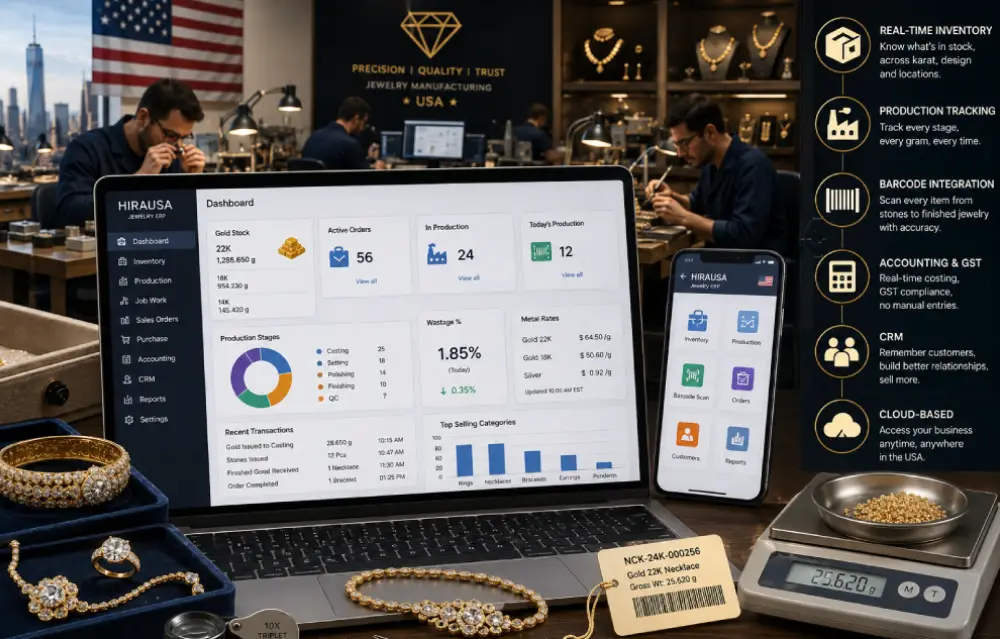
You know what’s in stock without asking anyone. Instead of calling the workshop to check how much 18K stock is left, the number is just there — by karat, design, and location, updated the moment something moves. That’s the real value of jewelry inventory and production management software: it replaces “let me check and call you back” with an answer you can see right now.
Production stops being a black box. In a manual setup, once a piece is out of sight you’re relying on memory and job cards to know where it is. Tracked digitally, you can assign work to a specific craftsman, see how long each stage is taking, and catch a delay or unusual wastage while it’s still fixable.
Small, expensive things stop going missing. Anyone who’s run a workshop knows how easily a loose stone ends up in the wrong tray. A jewelry ERP with barcode integration puts a scannable tag on everything from a single stone to a finished necklace, checked at every handoff instead of trusted to memory. Audits that used to take days start taking hours.
Your books would match your production floor in real time. Metal rates change daily and wastage differs by piece — if accounting isn’t wired into production, someone’s doing manual entries and hoping they got it right. A jewelry ERP with accounting and CRM built for this industry syncs costs and sales automatically, so margins are a real number, not a year-end surprise.
Customers get remembered, not just served. Knowing a customer bought a bridal set last year and prefers rose gold lets sales staff have a genuinely useful conversation instead of starting from zero.
Fewer mistakes, less wasted metal. A lot of the “shrinkage” manufacturers write off as normal wastage is really, human error — a weight typed in wrong, wastage estimated instead of measured. Removing manual entry removes most of it, often the biggest source of unexplained loss.
You’re not scrambling when the auditor calls. Digital systems keep a running, exportable record of every transaction, so documentation is a report you generate, not a week lost digging through files.
It grows with you. A manual system that barely works for one workshop tends to fall apart at a second location. A cloud-based setup scales by adding users and locations without rebuilding the process from scratch.
What to Actually Look for Before You Buy
Not every ERP that claims to work for jewelry actually, understands the business. Plenty of generic systems get bolted together with a few jewelry-sounding fields added on, and the cracks show fast — usually the first time someone tries to calculate wastage on a mixed-karat batch. Worth checking before you commit:
- Does it handle karat-wise inventory, or just generic SKUs?
- Does it track job work and production stages, not just finished-goods stock?
- Is barcode integration built in, or an expensive add-on?
- Does accounting sync automatically with GST, or does someone re-enter everything?
- Is there a real CRM piece, or is customer history tracked separately (usually meaning not at all)?
- Can it handle more than one branch without extra licensing headaches?
- Is it cloud-based, so you can check on things remotely?
This is the exact list we built HiraUSA around. It wasn’t designed as a generic ERP with jewelry features tacked on afterward — it was built from the ground up for jewelry manufacturers and retailers, bringing production tracking, inventory, barcode integration, accounting, and CRM into one place, so nothing gets checked twice or reconciled manually.
Two things worth clarifying before you move ahead: implementation is usually faster than people expect, with most businesses running day-to-day operations within a couple of weeks; and no, this doesn’t replace your craftsmen. The software tracks what’s happening — it doesn’t make anything. The setting, the polishing, the artistry stays entirely in human hands.
Where This Leaves You
Jewelry manufacturing has always run on trust — in your craftsmen, your numbers, and the idea that what left the workshop matches what gets sold. Automation doesn’t replace that trust; it gives you a way to verify it instead of relying on memory alone.
If you’re still reconciling gold weights by hand or chasing job cards to figure out where an order stands, it’s worth seeing what a purpose-built system looks like in practice. Reach out to the HiraUSA team for a free demo and see how a properly connected jewelry ERP system could work for your floor, your team, and your numbers.


