
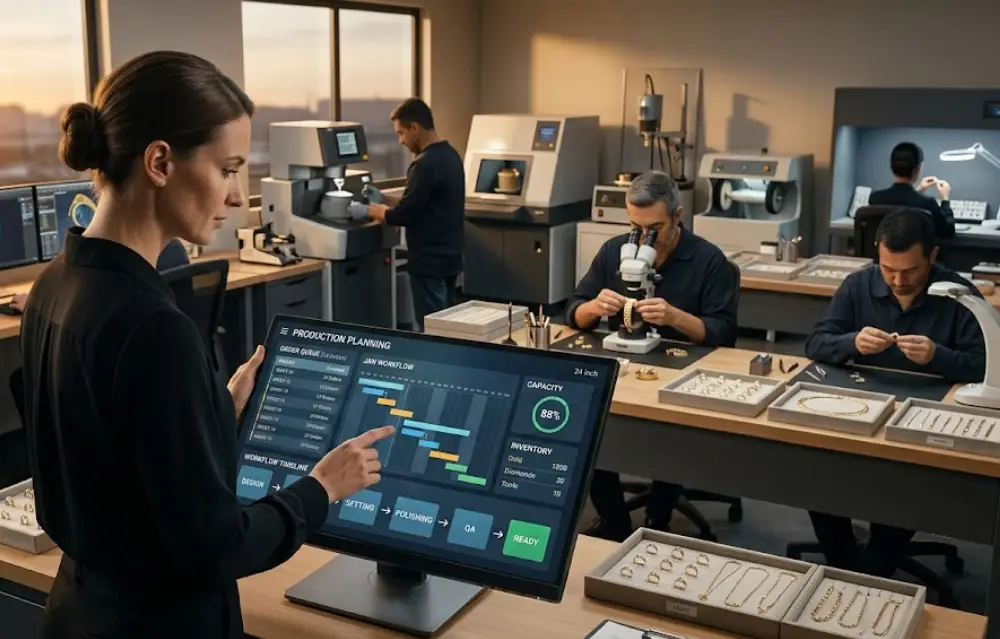
A manufacturer I know used to plan his month the same way every month: by looking at what orders were sitting on his desk and figuring out, roughly, who could make what by when. It worked fine when he had six Craftsmen and one showroom. It stopped working the day he opened a second location and started taking bulk orders for a wedding season. Suddenly he had Craftsmen sitting idle on some days and drowning in work on others, gold sitting unused in one workshop while another ran short, and orders slipping past their promised delivery dates for no reason anyone could quite explain.
That’s not a staffing problem or a skill problem. It’s a planning problem, and it’s one that quietly costs jewelry manufacturers far more than most of them realize — in idle labor, in rushed work that leads to more rejections, and in customers who don’t come back after their order was late twice in a row.
Why Production Planning Is Harder in Jewelry Than It Looks
On paper, production planning sounds simple: know what you need to make, know what you have to make it with, and schedule the work. In jewelry manufacturing, every part of that gets complicated fast.
- You’re not just planning labor hours — you’re planning gold, and gold must be tracked by karat, weighed at every stage, and accounted for down to the gram
- Orders vary wildly in complexity. A plain band and a hand-set bridal set don’t take the same time, the same skill, or the same materials, even if they’re both “one ring” on your order sheet
- Craftsmen often specialize — casting, setting, polishing — so a job isn’t just “assigned,” it moves through several people, and a bottleneck at any one stage slows everything behind it
- Seasonal demand swings hard. Wedding season and festival season can mean triple the order volume of a normal month, and if you haven’t planned capacity ahead of time, you’re improvising under pressure
- Raw material timing matters. Ordering gold too early ties up cash; ordering too late delays production
None of this shows up cleanly on a whiteboard or a notebook schedule. It needs to be tracked in a system that really understands how jewelry gets made — not just when an order is due.
What Good Production Planning Actually Looks Like
It starts with knowing what you have
You can’t plan production without an accurate picture of your raw material and stock position, and this is where most manual systems fall apart first. If nobody’s sure exactly how much 22K gold is sitting in the workshop right now, every production plan built on top of that guess is shaky from the start. Solid jewelry inventory management means knowing, at any moment, what raw material, semi-finished pieces, and finished stock you’re holding — by karat, by design, by location — so a production plan is built on real numbers instead of assumptions.
It matches workload to actual capacity
Once you know what you have, the next question is what your workshop can realistically produce in each window. This means understanding how many hours each Craftsman or stage can absorb and scheduling new orders against that capacity rather than just stacking them up and hoping. This is exactly where jewelry manufacturing automation software earns its keep — it can show you, at a glance, whether a new bulk order fits into next week’s schedule or whether it’s going to blow past your promised delivery date before you even confirm it.
It tracks a job through every stage, not just start and finish
A ring that’s “in production” could be at casting, at setting, or sitting in a polishing queue — and those are very different states with very different timelines. Good planning means visibility into exactly where each job is, not just a binary “started” or “done.” When a stage is running behind, you want to know today, not when the customer calls asking where their order is.
It plans material alongside labor
Scheduling Craftsmen without also scheduling gold procurement is only half a plan. If a big order comes in and the metal to make it hasn’t been ordered yet, your labor schedule is irrelevant. Proper jewelry inventory software ties material planning directly to production scheduling, so a new order automatically checks against what’s on hand and flags what needs to be procured, rather than someone discovering the shortfall halfway through the job.
It gives you a real picture before commitments get made
The biggest planning failures usually happen at the sales counter, when a promise gets made to a customer without checking whether production can really deliver on it. A connected system lets sales staff see real capacity and material availability before quoting a delivery date, which avoids a lot of the awkward calls that follow when a date can’t be kept.
Why This Needs to Live in One System
It’s tempting to handle planning with a mix of tools — a spreadsheet for schedules, a register for stock, WhatsApp for coordinating with Craftsmans. The problem is that no one talk to each other, so the plan is only as good as whoever remembered to update every piece of it that day. A proper jewelry manufacturing ERP solves this by connecting inventory, production stages, and scheduling in one place, so a change in one area — a delayed material delivery, a rush order, a Craftsman out sick — automatically reflects in the plan instead of getting missed.
This is the gap HiraUSA was built to close. Instead of separate tools that need to be manually kept in sync, it connects inventory, job work tracking, and scheduling into a single system, so production planning is based on what’s actually happening on the floor, not what someone remembers from yesterday stand-up.
What Changes When Planning Actually Works
Manufacturers who move from ad-hoc scheduling to a properly connected system tend to notice the same things: fewer Craftsmen sitting idle waiting for material, fewer rush jobs that lead to quality slips, and far fewer awkward conversations with customers about delayed orders. Wedding and festival season stop being chaos to survive and start being volume that’s been planned for weeks in advance.
None of this requires more staff or more workshop space. It mostly requires knowing, accurately and in real time, what you have and what you can truely produce — which sounds obvious, but is exactly the thing most manual systems fail to deliver.
Where This Leaves You
If your production planning still depends on a notebook, a whiteboard, and someone’s memory of who’s working on what, you’re not doing anything wrong — you’re just working with the wrong tools for the scale you’ve grown into. A system built specifically around jewelry inventory and manufacturing gives you the visibility to plan ahead instead of reacting to whatever’s loudest that day.
Get in touch with the HiraUSA team for a free demo and see how connected production planning could work for your workshop, your Craftsmen, and your delivery promises.


