

A mid-tier diamond wholesaler in New York’s Diamond District begins the morning reviewing two screens. On one monitor, their RapNet inventory is live, showcasing loose certified stones to buyers across North America, Europe, and Asia. On the second monitor, a spreadsheet tracks stones currently out on memo to retail partners across the city.
By 2:00 PM, a 2.50-carat oval cut out on memo is sold by a local boutique. Meanwhile, an international buyer finds that same stone on RapNet and places an urgent order.
What follows is an operational scramble: checking paper slips, calling the road salesperson, and ultimately making the difficult call to inform the buyer that the stone was already promised elsewhere.
This scenario plays out daily in diamond offices. While trading networks unlock unprecedented global market access, relying on disconnected spreadsheets or generic software to track inventorycreates blind spots. Modern diamond trading requires marketplace distribution and back-office control to operate in harmony.
Marketplace Discovery vs. Back-Office Operations
Understanding why inventory discrepancies happen starts with recognizing the distinct roles of a trading network and an ERP platform.
What RapNet Does Best:
RapNet serves as a premier B2B trading network and price benchmark for diamonds. It provides:
- Access to a global network of vetted buyers, wholesalers, and diamond manufacturers.
- Real-time market intelligence through the Rapaport Price List.
- A central marketplace to list and discover verified, certified diamonds.
In short, trading networks solve the problem of market reach, discovery, and pricing transparency.
Where Disconnected Systems Fall Short:
RapNet is built for trading, not internal business operations. When a business relies on manual updates or basic spreadsheets to bridge the gap between market listings and physical inventory, several friction points emerge:
- Memo Lag: Diamonds frequently move on memo for retail evaluation, trade shows, or setting. If an external listing does not immediately reflect that a stone is out on memo, the risk of double-selling skyrockets.
- Double Data Entry: Entering carat weight, color, clarity, cut, polish, symmetry, fluorescence, and lab report numbers into a spreadsheet, then re-entering that same data into online listings, wastes hours and introduces manual input errors.
- Margin Uncertainty: Quoting prices on the fly without an immediate view of landed costs—including grading fees, parcel yields, cutting loss, and shipping—can compress realized profit margins.
Request a Personalized Demo with HiraUSA Today →
Connecting the Front Line to the Vault: The Role of Diamond ERP Software
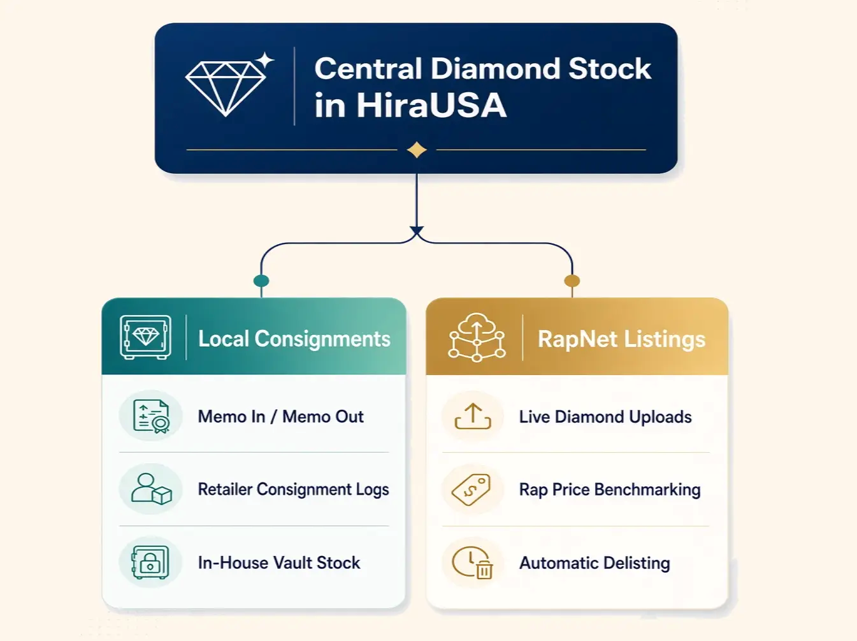
Dedicated diamond inventory management software acts as the single source of truth for every stone, parcel, and finished piece in your business. When backed by reliable diamond ERP software, your operational data feeds your sales channels cleanly.
1. Granular Diamond Inventory Tracking
Unlike standard retail SKUs, loose stones possess unique identities and shift through multiple stages before final settlement. Specialized diamond inventory software tracks:
- Current Status: In-vault, on memo to a customer, in transit, under manufacturing, or reserved.
- Physical Location: Main office safes, branch offices, trade show cases, or traveling sales kits.
- Parcel & Melee Dynamics: Breaking down loose parcels, tracking stones drawn for custom mountings, and monitoring balance carat weights without losing track of cost bases.
When a stone’s status changes in your back office, your records reflect that update instantly, safeguarding inventory accuracy.
2. Streamlined Lab Certificate Data Sync
Entering certification specs manually from GIA, IGI, or HRD reports takes valuable staff time. With modern diamond management tools, entering or scanning a certificate number pulls verified grading specs directly into your stock records:
- Measurements, depth, table, and girdle specs
- Polish, symmetry, and cut grades
- Digital report links and laser inscription notes
Once stored in HiraUSA, this structured data can be exported or pushed to RapNet without repetitive data entry.
3. Dynamic Pricing Tied to Market Benchmarks
Setting competitive trade prices requires balancing market rates against your actual acquisition costs. An ERP system allows wholesalers to apply clear formulas referencing Rapaport pricing:
- Establish discount or premium rules by shape, size, or color bracket (e.g., -25% Rap).
- Factor in true landed costs, including brokerage, certification fees, and shipping.
- Maintain separate pricing tiers for trusted memo partners versus public trading listings.
Operational Comparison: Managing Stock With vs. Without an ERP
| Operational Process | Disconnected Spreadsheets + Manual Trading | Integrated HiraUSA ERP Workflow |
| New Intake | Manually type 20+ stone specs into separate spreadsheets. | Retrieve lab data by cert number; record populated instantly. |
| Memo Management | Handwrite paper slips; reconcile days or weeks later. | Generate digital memo; stone status updates to “On Memo” immediately. |
| Marketplace Listings | Re-type stone details or upload manual CSVs periodically. | Export clean, verified stock data formatted for trading networks. |
| Parcel Tracking | Approximate remaining weight manually after pulling stones. | Accurate carat depletion and updated cost-per-carat calculations. |
| Stock Audits | Tedious, multi-day physical counts reconciling binders. | Rapid digital audits via barcode or RFID scanning against live records. |
3 Real-World Workflows for Modern Jewelers
Scenario 1: Managing High-Carat Memos Without Stock Confusion
A long-time retail partner requests two 3-carat round diamonds for an in-store client consultation over the weekend.
- The inventory manager scans the stones into HiraUSA under Memo Out, logging client terms and insurance conditions.
- The software flags these stones as unavailable for immediate sale, preventing conflicting commitments.
- If the retailer sells one stone and returns the other, the ERP converts the sold diamond into an accounts receivable invoice and returns the unsold diamond directly to vault inventory.
Scenario 2: Intake of Loose Parcels for Custom Manufacturing
A 100-carat lot of melee diamonds arrives from an overseas supplier.
- The lot is entered with total weight, cost per carat, and import fees to calculate true landed cost.
- As jewelers pull specific stones to pave halo engagement rings, the ERP deducts the precise carats used and adds that raw material cost directly into the ring’s Bill of Materials (BOM).
- The remaining parcel weight and valuation stay fully balanced without manual spreadsheet adjustments.
Scenario 3: Multi-Location Management for Trade Shows
Preparing for a major trade show requires taking high-value goods on the road.
- Staff creates a temporary “Trade Show” sub-location within the ERP and scans the selected stones into that location.
- While sales reps present stones on the trade show floor, the main office retains full visibility into what has been presented, what is out on memo, and what has been invoiced.
- Unsold items are scanned back into the main vault at the end of the show, completing the audit trail.
Take Control of Your Diamond Inventory with HiraUSA
Relying on manual logs and disconnected spreadsheets costs diamond businesses valuable hours, creates stock errors, and strains trade relationships.
Pairing your global sales reach with purpose-built diamond inventory management software gives your team the inventory accuracy, memo control, and cost transparency needed to trade confidently.
Want to see how HiraUSA simplifies diamond tracking for your business?
Request a Personalized Demo with HiraUSA Today →
Frequently Asked Questions
What is the main difference between RapNet and diamond ERP software?
RapNet is an external B2B trading network used for sourcing diamonds, discovering buyers, and benchmarking prices. Diamond ERP software, like HiraUSA, is your internal operating system used to track physical inventory, run accounting, manage consignments (memos), maintain customer ledgers, and oversee jewelry manufacturing.
Can HiraUSA manage both loose stones and finished jewelry?
Yes. HiraUSA is engineered for both sides of the trade. It manages loose diamonds by carat weight, cut, and lab certificate, as well as finished fine jewelry, raw precious metals, gemstones, and assembly labor.
How does diamond inventory software prevent double selling?
When a diamond is checked out on memo, assigned to a custom design order, or marked as sold, the software updates its internal status in real time. This ensures sales staff never offer a stone that is already out with a client or committed to another buyer.
Can I track diamond parcels and melee alongside single certified stones?
Yes. The software handles both serialized, single-stone certified inventory and bulk melee parcels. When diamonds are extracted from a parcel for mounting or grading, the system updates remaining carat weights and recalculates inventory valuations automatically.
How does certificate data import work?
Instead of typing every grading detail manually, you can pull verified specifications using the report number from major grading laboratories like GIA. This data populates directly into your inventory records, ready for stock tagging or trading uploads.
“Notice: Some advanced automations and integrations described here are part of an ongoing staged rollout. For currently available features and tier inclusions, refer to the HiraUSA Pricing & Feature Matrix.”


